
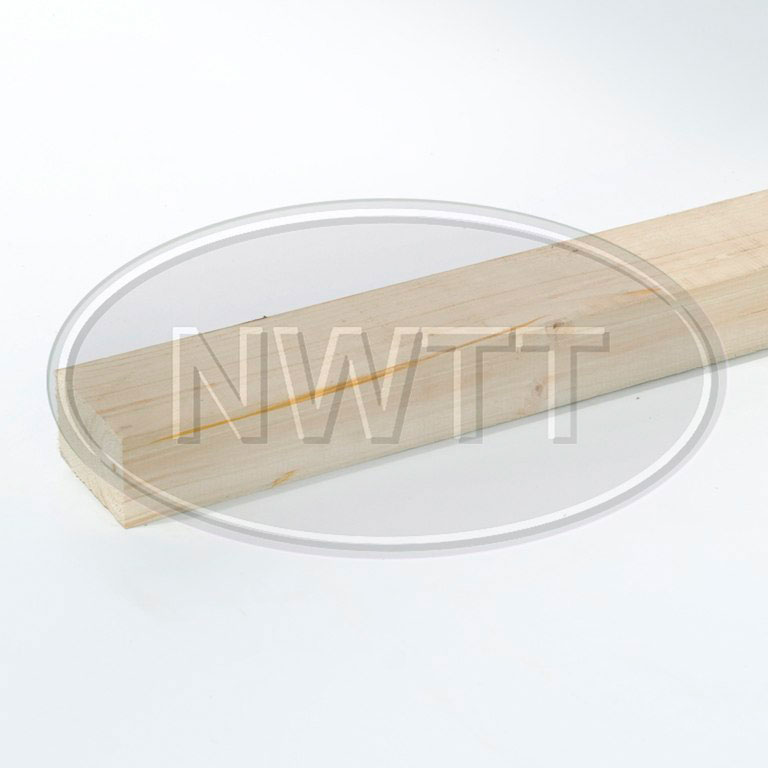
Studwork timber in two forms. CLS timber is planed on all four sides with eased edges, giving consistent sizing and a clean face for framing partitions and stud walls. Scant is a rough-sawn section - chunkier, cheaper per metre, and suited to heavier frames or anywhere a finished face is not needed. Both stocked in a range of lengths to suit standard wall heights.
CLS or scant?
CLS is machined to a consistent finished size with rounded edges, and that consistency is what makes it quick to work with - studs sit square, board sits flat against the face, and you are not sorting through a pack looking for straight lengths. It is the default for internal partitions and for any frame that will be boarded and skimmed.
Scant is sawn rather than planed, so the section is slightly larger, the surface rougher and the price per metre lower. It suits carcassing, structural framing and anywhere the timber will end up hidden, or where the extra section is doing real work. Our guide to CLS timber goes into the difference in more detail.
Sizes and centres
Both are described differently from sawn timber, so check what you are ordering. CLS is quoted on its finished planed dimension; scant is quoted on its sawn size before machining. Set studs at 400mm or 600mm centres to suit board thickness and load, and allow for sole plate, head plate and noggins when working out how much you need — the plates and noggins on a partition often add up to more than people expect.
Match your insulation width to the centres you have chosen so it friction-fits between studs rather than needing trimming on every bay.
Timber Information
Please be aware that all of our timber products—including fencing, structural, joinery, and decorative timber—are natural materials and may display characteristics inherent to wood.
While many of our timbers are seasoned (kiln-dried) to reduce internal moisture and minimise movement such as bending, twisting, or warping, some movement may still occur over time due to environmental conditions.
As a natural product, timber may also exhibit the following features:
Splits and shakes (natural cracks or separations in the grain)
Knots and knot holes
Colour variations between boards or within the same piece
Grain pattern differences
Surface checking or minor imperfections
Nominal sizing – all timber dimensions are approximate and not finished sizes
Distortion after pressure treatment – joinery and kiln-dried timbers may distort after treatment, which is beyond our control and non-refundable
These characteristics are not considered defects, but rather part of the unique beauty and authenticity of real wood. We recommend allowing timber to acclimatise to its environment before installation and following best practices for storage and handling.
If you have specific requirements for appearance or performance, please contact our team before making a purchase.