
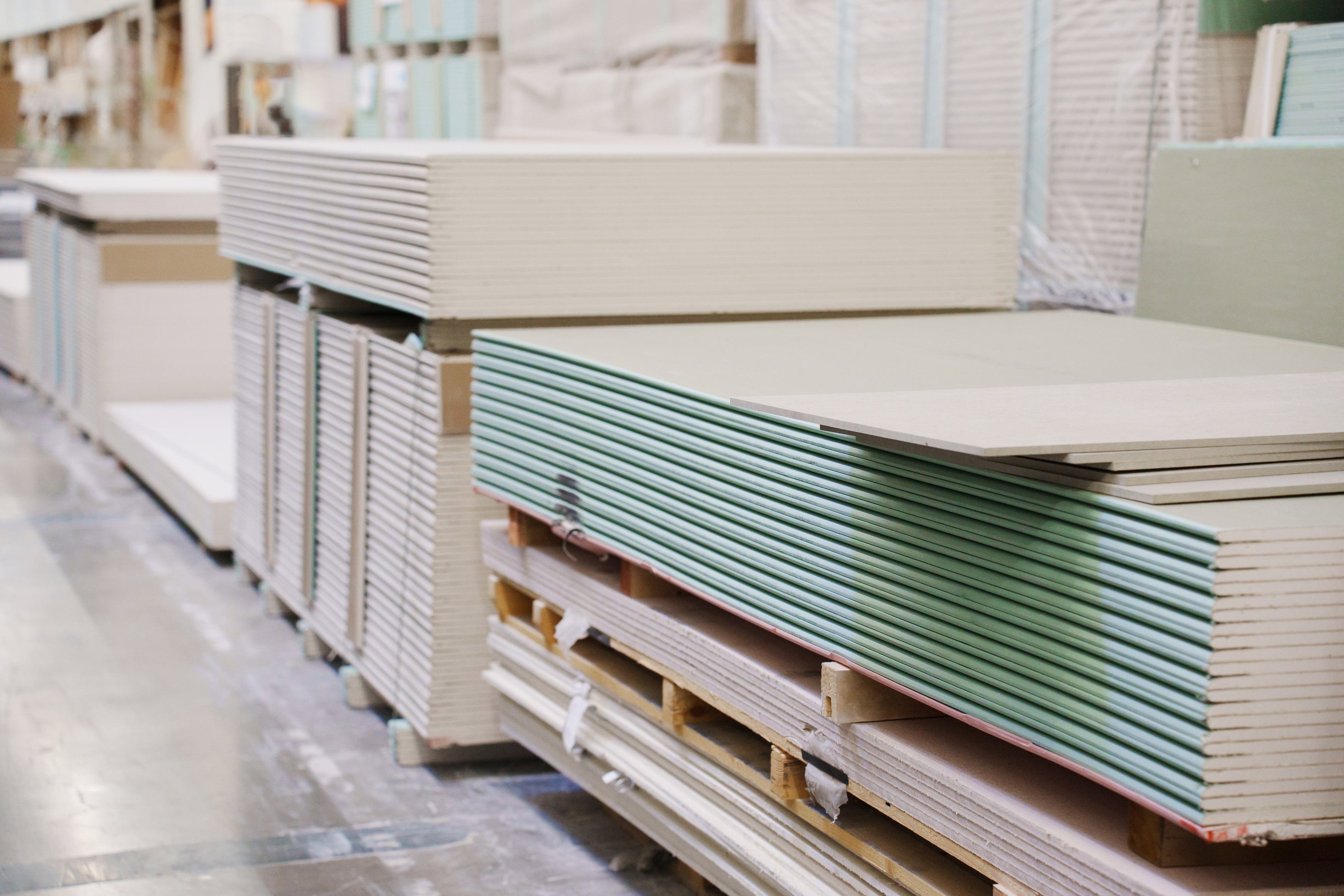
Getting your plasterboard quantities right before you order saves time, money, and a frustrating second trip to the timber merchant.
Under-ordering could leave you waiting on a delivery mid-job, while over-ordering will leave you with bulky materials that are awkward to store and costly to return.
This guide covers the full plasterboard calculation process for walls and ceilings, the variables that affect your total, and how to work out adhesive quantities for dot-and-dab applications.
The basic formula for plasterboard calculations
Forget a plasterboard calculator – follow these simple steps to calculate how much plasterboard you need at the start of your next job.
Just remember, you need to follow each step for every room or surface.
- Measure each surface
For each wall or ceiling, multiply the length by the height (or width for ceilings) to get the area in square metres. Add all surfaces together to work out the room total. - Deduct openings Subtract the area of doors and windows from your total. A standard door is approximately 1.89m2 (2.1m x 0.9m), while a standard window is approximately 1.44m2 (1.2m x 1.2m). Note that cutting around openings does increase offcuts, so don’t reduce your wastage allowance when deducting for them.
- Divide by sheet area A standard 2400 x 1200mm sheet covers 2.88m2, so divide your net area by 2.88 and round up to the nearest whole sheet.
- Add wastage To account for wastage, add 10% on a straightforward job with minimal cutting. Increase to 15% for complex layouts, including multiple angles, stairs, or rooms where boards cannot run in full lengths.
Formula: Net area (m2) divided by sheet area (m2) = number of sheets, then add wastage
Worked example
Plasterboarding the walls only of a room measuring 4m x 3m with a 2.4m ceiling height, one door and one window.
- Wall 1 (4m x 2.4m) : 9.6m²
- Wall 2 (4m x 2.4m): 9.6m²
- Wall 3 (3m x 2.4m): 7.2m²
- Wall 4 (3m x 2.4m): 7.2m²
- Total wall area: 33.6m²
- Deduct door (1.89m²) and window (1.44m²): 33.6 minus 3.33 = 30.27m²
- Divide by 2.88: 10.51, rounded up to 11 sheets
- Add 10% wastage: 11 x 1.10 = 12.1, order 13 sheets
Standard plasterboard sheet sizes
Two sheet sizes account for almost all UK trade applications and jobs:
| Size | Area per sheet | Best for... |
| 2400 x 1200 mm (8ft x 4ft) | 2.88m² | Standard walls and ceilings, and most day-to-day applications. |
| 1800 x 900 mm (6ft x 3ft) | 1.62m² | Loft conversions, stairwells, tight access, and solo working jobs. |
Board orientation matters for your calculations. Always fix the long edge running parallel to the stud or joist centres (400 mm or 600 mm). Fixing boards in any other way creates unnecessary joins, weakens the surface, and increases the number of sheets needed.
Choose the right plasterboard types
Board type doesn’t affect plasterboard estimator calculations - the formula above is the same regardless of specification.
It does, however, affect the cost per sheet and whether the job will meet building regulations once complete, so always confirm before ordering from your chosen plasterboard.
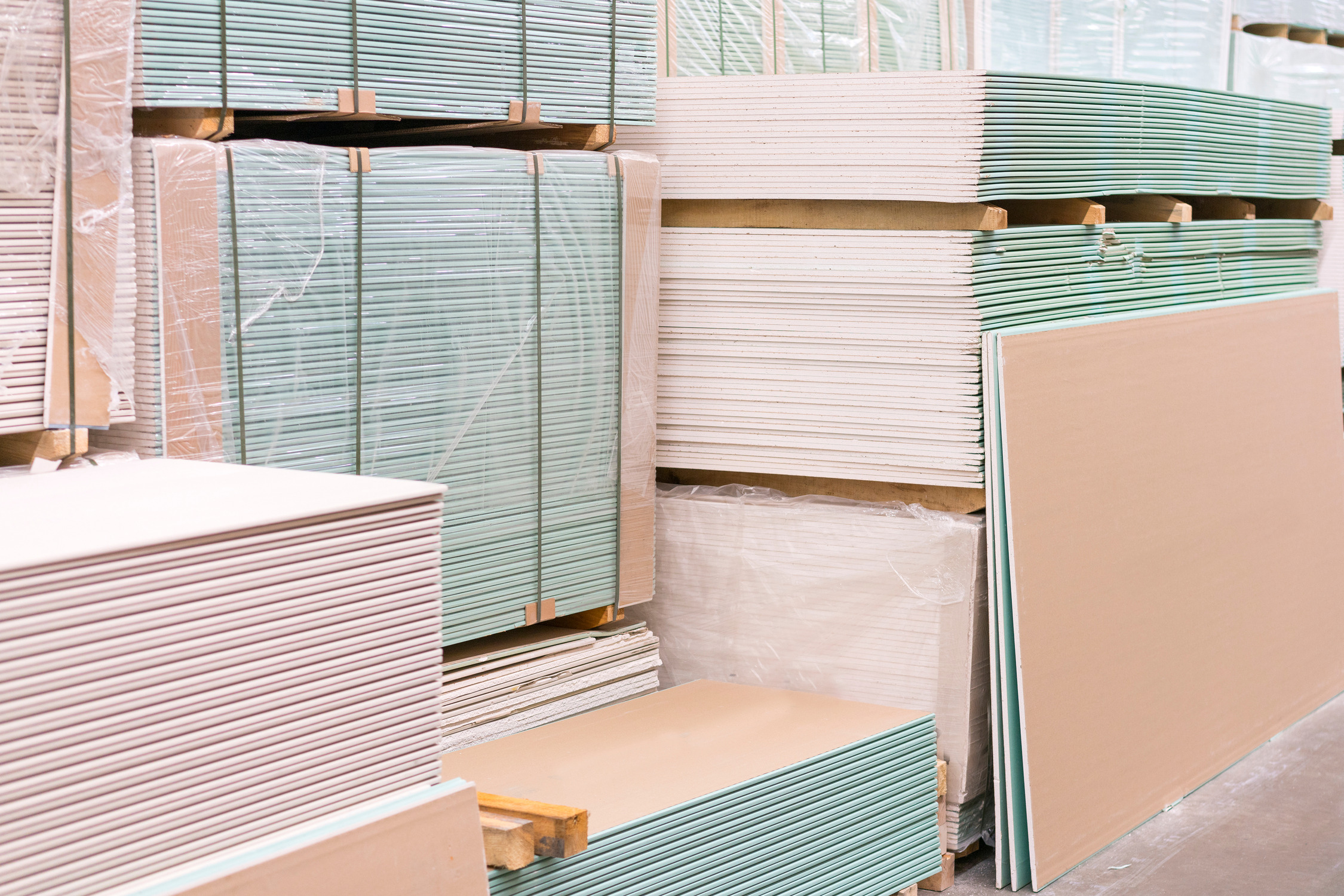
| Board type | Face colour | When to specify |
| Standard | Grey or ivory | General walls or ceilings in dry internal areas. |
| Moisture-resistant | Green | Bathrooms, en-suites, kitchens, utility rooms, or anywhere with steam and condensation. |
| Fire-rated | Pink | Party walls, garage-to-house walls, and walls required for fire compartmentation. Specific ratings can be found in the building regs. |
| Acoustic | Blue | Party walls, bedrooms, home offices, or anywhere sound separation is needed. |
| PIR insulation | Depends on the manufacturer | External walls where thermal improvement is required - check Part L compliance. |
One thing worth flagging on fire-rated board: compartmentation only performs as a complete system. A correctly specified fire-rated wall is undermined by an untested door in it, so where the wall needs a rating, the opening needs a matching fire door and doorset.
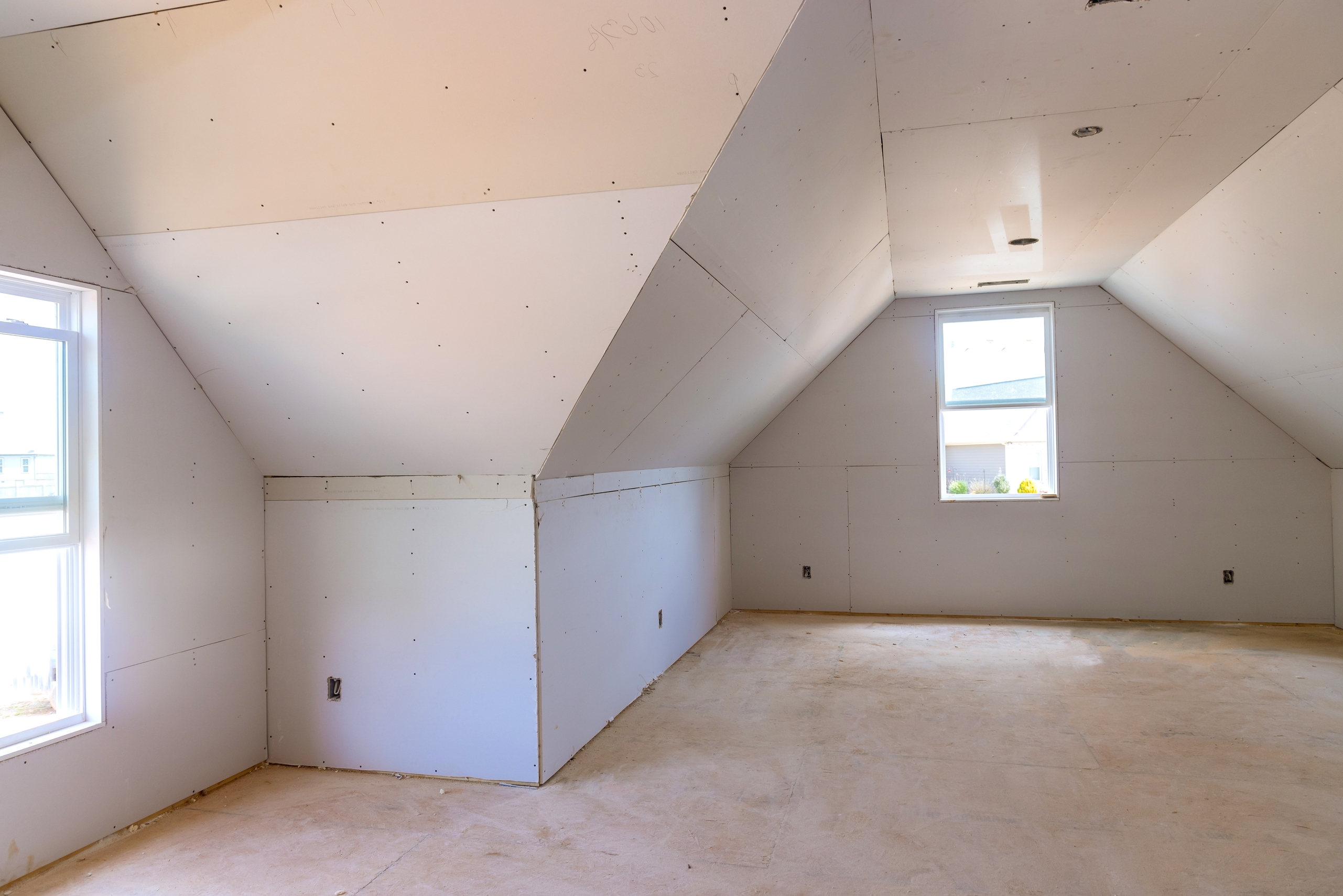
Screw-fixed vs dot-and-dab - how the fixing method affects installation
The fixing method required changing the full materials list, not just the board count. Make sure you are pricing for the correct method for your job before ordering.
Screw-fixed to timber or metal stud
The standard method for partition walls and ceilings. The boards are fixed directly to the CLS timber stud or joist frame with drywall screws.
- Fix at 300mm centres on walls, 230mm centres on ceilings
- 38mm screws for timber stud, 25mm screws for metal stud
- Allow approximately 30 screws per standard 2400 x 1200mm sheet
- No adhesive required
Dot-and-dab (direct to masonry)
Used on brick, blockwork, or concrete masonry walls, and not suitable for ceilings. Boards are fixed using a bonding compound applied in dabs directly to the wall face.
- No screws required through the board face, though additional mechanical fixings can be added for security
- Coverage rate for a 25kg bag of bonding compound: approximately 2.5 to 3.0m² of wall area
- Allow 10% wastage on adhesive quantities on top of the calculated amount
If you are opting for this method, bear in mind that dot-and-dab boards cannot support heavy fixings directly, so you may need cavity wall anchors or blocking behind for load-bearing. Likewise, if you are tiling, leave it to cure for at least 72 hours first.
How much plasterboard adhesive do I need?
If you are fixing by dot-and-dab, use the following formula to calculate how many bags of bonding compound to order:
Formula: Total wall area (m²) divided by coverage rate per bag = number of bags, then add 10% wastage
The NWTT universal bonding compound comes in a 25kg bag with a coverage rate of approximately 2.5 to 3.0m² per bag under standard dot-and-dab application. Use 2.75m² as your working figure for most jobs.
A worked example
20m² of masonry wall to be dot-and-dabbed:
- 20m² divided by 2.75m² per bag = 7.27 bags, rounded up to 8
- Add 10% wastage: 8 x 1.10 = 8.8, order 9 bags
Please note: Coverage is reduced on rough or uneven masonry walls, as thicker dabs are needed to bring the board face out to a consistent plane. On particularly rough brickwork or blockwork, work to a coverage rate of 2.0 to 2.5m² per bag of adhesive and adjust your order accordingly.
Estimating for multi-room and multi-surface projects
For full house renovations, new builds, or commercial fit-outs, a room-by-room approach might take longer, but it keeps the estimate accurate and the ordering process more straightforward.
- Calculate each surface separately - Walls and ceilings often require different board orientations and may require different board types, so keeping them separate avoids errors.
- Order plasterboard types in groups - If a job mixes board types across rooms, tally each type separately and order them as distinct lines. Mixing moisture-resistant and standard boards in a single order, for example, makes it easy to order the wrong amount or put the wrong board in the wrong location on site.
- Keep separate materials lists if the job mixes fixing methods - Need to dot-and-dab on external masonry walls and screw-fix on internal stud partitions? Keeping two separate materials lists and calculating adhesive and screws independently can vastly reduce the risk of errors.
- Add a 5% project-level contingency on top of your individual room totals for a multi-room job - This covers unforeseen wastage, damaged boards on longer projects, and the inevitable last-minute additions.
- Order boards for the same room from the same production batch where possible - Face colour and texture can vary slightly between batches, which becomes visible under certain lighting once the boards are skimmed and decorated.
- Take advantage of trade accounts - Save money with bulk pricing and get preferential order handling with NWTT trade accounts.
Quick reference number for estimating
| Item | Figure |
| Standard sheet size | 2400 x 1200mm |
| Standard sheet area | 2.88m² |
| Standard wastage allowance | 10% |
| Complex layout wastage allowance | 15% |
| Screws required per sheet (timber studs) | Approx. 30 |
| Screw centres (walls) | 300mm |
| Screw centres (ceilings) | 230mm |
| Screws for timber stud | 38mm |
| Screws for meta stud | 25mm |
| Adhesive coverage (per 25kg bag, dot-and-dab method) | 2.5 to 3.0m² per bag |
| Adhesive wastage allowance | 10% |
| Dot-and-dab curing time | Around 72 hours, but check the manufacturer's advice |
Certainty and on-site success with NWTT
Getting the prep, measurements, and ordering right gives you the best chance of highlighting your skills as you get to work.
For stress-free working days and happy customers, speak to the team at your nearest branch or call us on 01942 720 777, and we’ll help however we can.